English/US



ANPAD has released the revised Manual of Good Practices in Scientific Publishing and the recommendations prepared by the Ethics Committee, which together provide guidance to authors on the ethical and responsible use of Generative Artificial Intelligence (GenAI) in scientific production.
 What the manual says
The revised manual, published in May 2025 (version 2.1), sets guidelines for the use of AI in scientific publishing. Notably, it recommends that reviewers refrain from using GenAI tools during reading, writing, and review. The document also recommends that journals adopt policies governing the use of GenAI in editorial management and advises authors to follow ethical and transparent practices, disclosing the use of such tools in a dedicated section of their manuscripts. In addition, the manual reaffirms that authorship must remain fundamentally human, with authors bearing full responsibility for the content, originality, and ethical compliance of their work.
The document “Special Recommendations to Authors,” prepared by ANPAD’s Ethics Committee together with the Working Group for Updating the Manual of Good Practices, reinforces the principles already established in the manual: transparency in the use of Artificial Intelligence throughout the research process, preservation of the originality of scholarly work, and maintenance of human authorship.
Perceptions on the use of AI 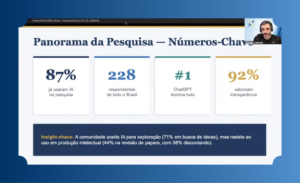
Following the update to the Manual of Good Practices in Scientific Publishing, a survey was conducted among the academic community affiliated with ANPAD to understand practices, perceptions, and ethical principles related to the use of Artificial Intelligence (AI) tools in academic research. The survey, which received 228 responses, found that 87% of participants had already used AI in their work, while 13% reported never having used such tools.
The findings show that the academic community tends to accept the use of AI in research-support tasks, such as idea exploration, a practice endorsed by 71% of respondents. By contrast, there is greater resistance to its use in activities related to intellectual production, with 44.3% of participants approving and 37.6% rejecting it.
Among the principles identified as most important for guiding the use of AI in academic research, ethics stood out, cited by 92% of respondents, followed by reproducibility, cited by 88.4%.
More information 
A recording of the livestream presenting the report is available on ANPAD’s YouTube channel: Uso da Inteligência Artificial na Pesquisa Acadêmica: Práticas, Percepções e Princípios Éticos – YouTube.
The report is available (in Portuguese) at 2026 Report